By Regina Shakespeare, Founder, My Billing Solution
Last updated: November 2, 2026
Billing at a methadone clinic comes down to volume. AHCCCS’s published fee schedule pays about $6 for the methadone administration code, so an opioid treatment program (OTP) has to bill hundreds of doses a day, keep eligibility current on hundreds of patients, and follow up on every denial. Many in-house teams weren’t built for that much data, and clinics may not realize how far behind they are until they review their accounts receivable (AR).
We’ve seen a common pattern in the industry: three full-time billers working hard, yet still struggling to keep up. The problem isn’t always the people doing the work. It’s the amount of billing activity a high-volume facility needs to manage every day.
Key Takeaways
- AHCCCS’s published fee schedule pays about $6 for the methadone administration code, making accurate, high-volume billing essential.
- Methadone clinics with large AHCCCS patient populations must keep up with frequent eligibility changes.
- Manual billing processes can lead to late claims, missed follow-up, and growing accounts receivable.
- Automated eligibility checks can cover hundreds of patients in under 20 minutes.
- When adding billing staff no longer reduces the backlog, it may be time to reconsider the facility’s billing approach.
Why Is Billing So Hard for Methadone Clinics?
Methadone clinic billing is challenging because facilities must manage large numbers of recurring services, relatively small payments for individual dosing codes, and constantly changing insurance eligibility.
Unlike a small medical practice that may see a handful of patients each day, a busy opioid treatment program can serve hundreds of patients. Each dose must be documented and billed correctly, and payments must be tracked.
That creates an enormous amount of administrative work.
A billing team must monitor claims, verify eligibility, investigate denials, follow up on unpaid balances, and keep accounts receivable organized. When these responsibilities depend heavily on manual processes, even a well-staffed department can fall behind.
The difficulty isn’t simply a staffing problem. It’s also a question of whether the facility’s billing process can handle the volume.
How Much Does AHCCCS Pay for a Methadone Dose?
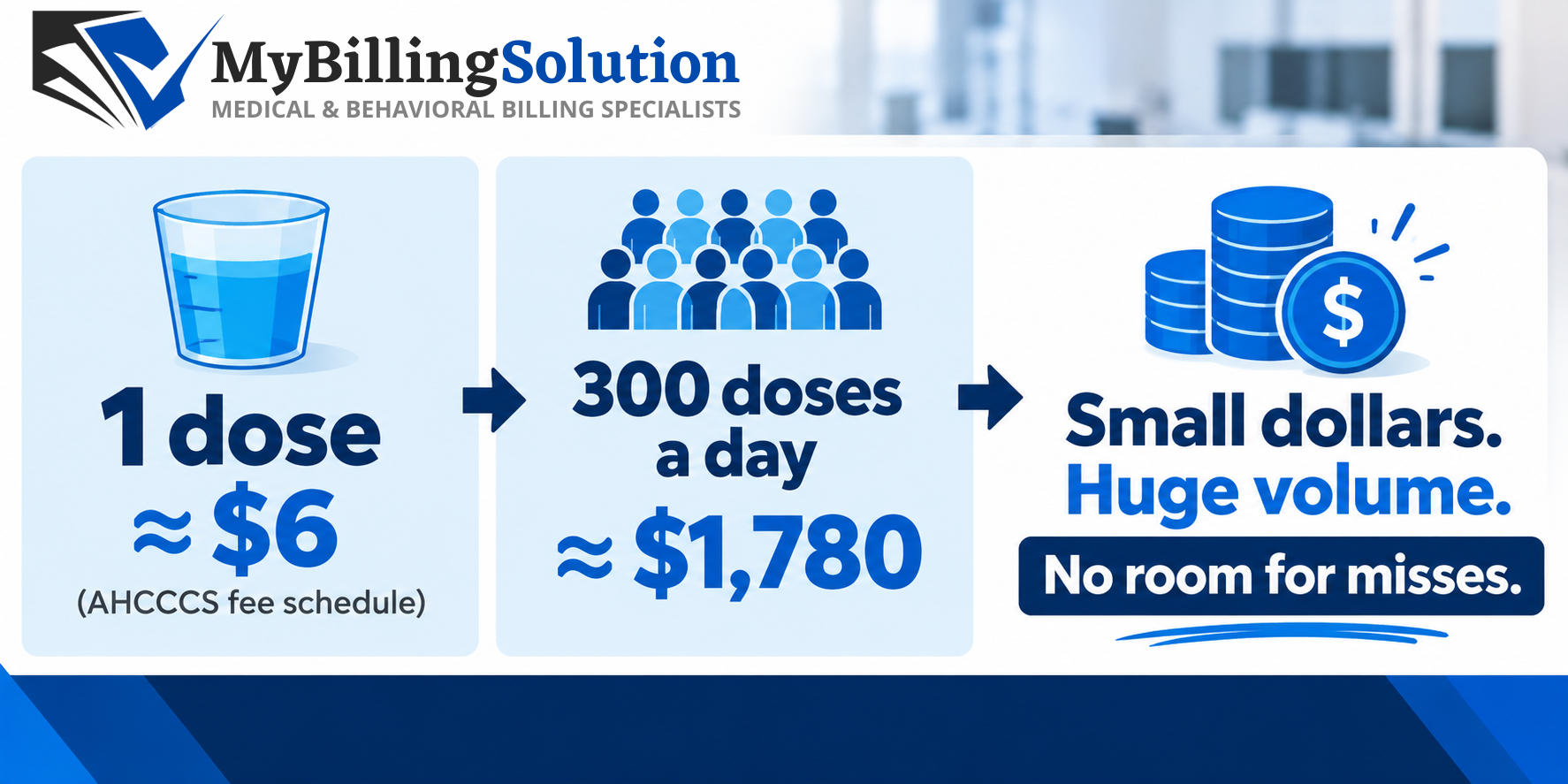
According to AHCCCS’s published April 2025 medication-assisted treatment fee schedule notice, the H0020 code for methadone administration and related services has the following rates:
- $5.93 on the managed care organization (MCO) fee schedule.
- $6.80 on the fee-for-service (FFS) schedule.
These rates became effective April 1, 2025. Individual health plan contracts may differ, and clinics may bill separately for other covered services, including counseling and assessments.
Consider a facility administering 300 doses in one day.
At the published $5.93 MCO rate, those 300 dosing services represent approximately $1,779 in potential reimbursement before accounting for other services or contractual differences.
That’s a substantial number of individual billing transactions, each representing a relatively small amount of revenue.
For comparison, Medicare’s 2026 opioid treatment program payment schedule lists a national rate of $277.29 for the G2067 weekly methadone treatment bundle. That bundle includes additional treatment services and is not directly comparable to AHCCCS’s individual H0020 dosing rate.
For facility administrators, the lesson is straightforward: high-volume methadone billing leaves little room for repeated mistakes or missed claims.
What Happens When In-House Billers Fall Behind?
What we see: It’s common for high-volume methadone clinics to have multiple full-time billing employees and still struggle to keep their claims current.
Three full-time billers may be processing claims every day, but the backlog continues growing.
Often, the underlying problems are familiar:
- Claims aren’t submitted as quickly as services are provided.
- Eligibility information isn’t updated consistently.
- Denied claims sit without timely follow-up.
- Billing staff spend significant time correcting preventable errors.
- Aging reports grow without a clear picture of what’s still collectible.
Over time, accounts receivable can climb into the hundreds of thousands of dollars before anyone has a reliable understanding of how much can still be recovered.
Adding another employee doesn’t necessarily fix the problem if everyone is working within the same outdated process.
A facility may be spending heavily on internal billing operations while still allowing revenue to remain uncollected.
That’s why reviewing billing performance matters just as much as reviewing staffing levels.

Why Does Eligibility Matter So Much at a Methadone Clinic?
Eligibility verification is especially important because methadone patients may remain in treatment for months or years, while their AHCCCS coverage can change throughout that time.
For Arizona opioid treatment programs serving large AHCCCS populations, changes in coverage can affect a substantial number of recurring claims.
Patients may move between health plans, lose coverage, regain eligibility, or receive coverage approvals after services have already been provided.
If a clinic verifies eligibility only when a patient first enrolls, it may miss changes that affect subsequent visits.
One overlooked eligibility issue can create a series of denied claims when the same patient receives services repeatedly.
Facilities also need to monitor previously uncovered dates of service. When coverage is approved retroactively, earlier services may become eligible for billing under applicable AHCCCS rules.
The key is to identify these changes before they turn into a larger accounts receivable problem.
This is why methadone clinics need an ongoing eligibility process rather than relying entirely on verification at intake.
What Do Automated Eligibility Checks Change?
Automated eligibility checks allow high-volume facilities to verify coverage for large patient populations without assigning staff to review every record individually.
At My Billing Solution, we can check eligibility for hundreds of patients in under 20 minutes.
For a facility with hundreds of active patients, that makes a meaningful difference in the amount of staff time devoted to repetitive eligibility work.
We also provide weekly AHCCCS eligibility reports so facilities can stay informed about coverage changes affecting their patients.
The importance of this process extends beyond methadone clinics.
According to Experian Health’s 2025 State of Claims report, 55% of surveyed healthcare providers reported that re-running an eligibility check takes 10 minutes or more, compared with 43% in 2024.
When eligibility work is performed manually across a large patient population, those minutes can quickly become hours of administrative work.
Automated eligibility checks help facilities spend less time on repetitive verification and more time addressing problems that need attention.
For clinics struggling with these demands, having a reliable eligibility process as part of their billing and collections services can help prevent avoidable billing disruptions.

How Do You Know Your Clinic’s Billing Is Falling Behind?
A methadone clinic doesn’t have to wait for a major financial problem to recognize that its billing department is overwhelmed.
Several warning signs can appear long before the full impact is visible in the facility’s financial reports.
Watch for these common warning signs:
- Claims are going out late. Services are provided regularly, but claim submission can’t keep pace.
- Accounts receivable keeps growing. The facility has substantial outstanding balances, but leadership can’t easily determine which claims remain collectible.
- Eligibility is checked when someone has time. Coverage verification becomes a secondary task rather than a consistent part of daily billing operations.
- Denials are piling up. Billing employees are too busy submitting new claims to investigate and correct older ones.
- Billing staff regularly work overtime. Employees are putting in additional hours without making meaningful progress on the backlog.
These problems often overlap.
For example, insufficient eligibility checks may lead to denials, which require additional staff time for corrections. That leaves fewer hours for submitting new claims, creating another backlog.
A facility should be able to review its accounts receivable, claim submission performance, and outstanding denials without spending days gathering information.
If that visibility is missing, it may be time for a closer review of the billing process.
When Does It Make Sense to Outsource Methadone Clinic Billing?
Outsourcing methadone clinic billing becomes worth considering when a facility’s patient volume exceeds what its internal billing team can consistently manage.
A small practice seeing eight patients per day has very different billing requirements from a facility with ten physicians collectively seeing 80 patients daily.
For an opioid treatment program administering hundreds of doses, the difference can be even greater.
More patients mean more eligibility checks, more claims, more payment records, and more opportunities for errors.
As volume increases, hiring additional billing staff may become expensive without necessarily resolving the underlying problems.
An experienced billing partner should understand the requirements of methadone clinics, AHCCCS billing, denial follow-up, and high-volume claim processing.
It should also provide reliable reporting so facility leadership understands where revenue stands and which problems need attention.
At My Billing Solution, we work with behavioral health facilities that need billing support capable of handling substantial patient and claims volume.
Our approach focuses on accurate claim submission, automated eligibility checks, consistent follow-up, and clear financial reporting.
For additional guidance, see our article on when to outsource billing for behavioral health providers.
Run a methadone clinic or opioid treatment program in Arizona?
Request a Free Revenue Analysis from My Billing Solution. We’ll help you understand where your facility’s billing stands and identify areas that may need attention.
Call (480) 369-3090 to learn more.
Frequently Asked Questions
What billing code do methadone clinics use for dosing in Arizona?
AHCCCS uses HCPCS code H0020 for methadone administration and related services. Medicare uses weekly opioid treatment program bundles, including G2067 for methadone treatment. Billing requirements depend on the payer and services provided.
How much does AHCCCS pay for methadone?
AHCCCS’s published April 2025 fee schedule lists $5.93 for H0020 on the MCO fee schedule and $6.80 under fee-for-service. These figures apply to the dosing-related code, not every service a methadone clinic provides. Actual reimbursement may vary by health plan contract.
How often should a methadone clinic check AHCCCS eligibility?
A practical approach is to verify eligibility at admission, before claims are submitted, through a full weekly review, and again shortly after the first of each month. Consistent checks help facilities identify changes that might otherwise lead to denied or missed claims.
Can a billing company work with our existing EHR?
Yes. My Billing Solution has experience working with a variety of electronic health record (EHR) and practice management systems. We can work with existing software to help minimize disruptions when transitioning billing responsibilities.